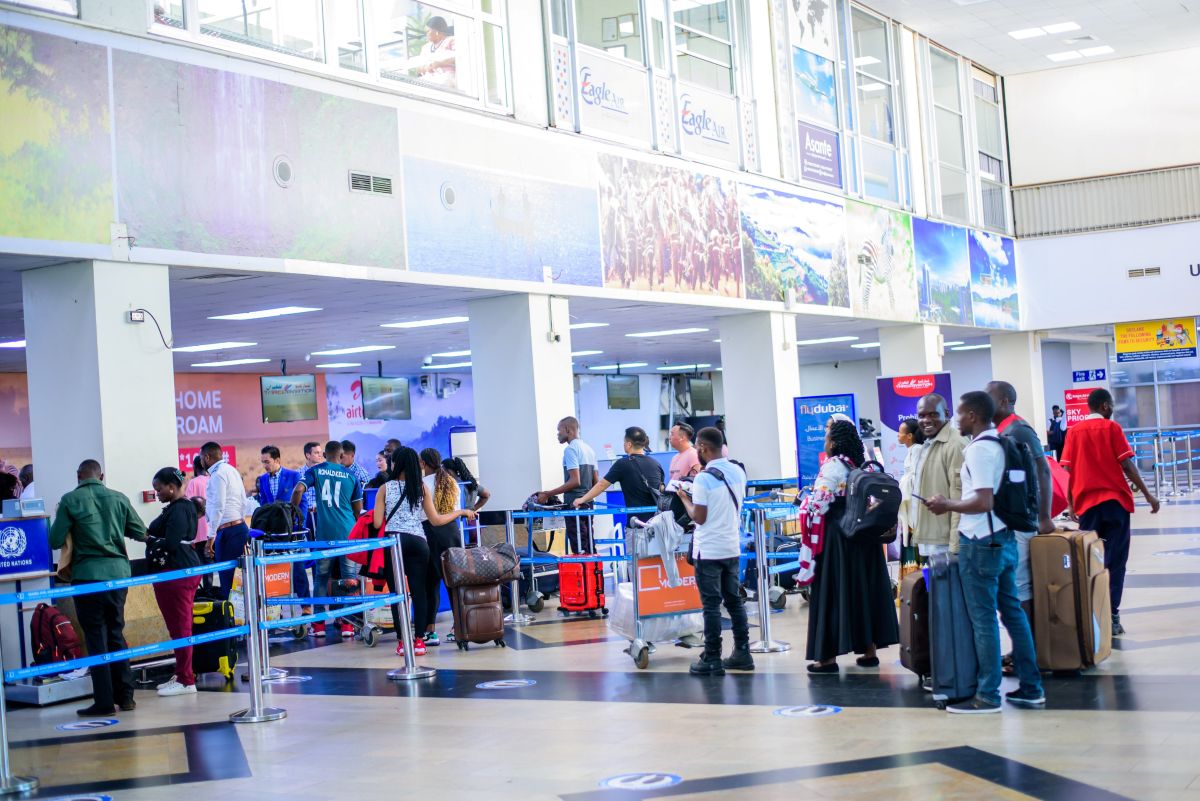

Entebbe International Airport recorded a 10.8 per cent decline in international passenger traffic during the first half of 2026 as disruptions in the Middle East, airline schedule adjustments and regional health concerns weighed on global travel.
Despite the slowdown, growth in aircraft movements, domestic travel and transit traffic pointed to resilience within Uganda’s aviation sector amid a turbulent operating environment.
The airport recorded its first major traffic slowdown in recent years, with recent data from the Uganda Civil Aviation Authority (UCAA) showing that Entebbe handled 1,010,961 international passengers between January and June 2026, compared with 1,133,366 during the same period in 2025.
This decline marks the most significant reversal in passenger growth since the aviation industry’s recovery from the COVID-19 pandemic.
According to UCAA Manager for Public Affairs Vianney Luggya Mpungu, the slowdown was driven by a combination of exceptional external events rather than declining interest in Uganda as a travel destination.
“June traffic recorded a lower figure than the same month last year. Half a year isn’t any better due to the closure of parts of the Middle East airspace in March and the subsequent events,” Luggya said.
The closure of sections of Middle East airspace following heightened regional tensions forced airlines to reroute flights, disrupted global schedules and increased operating costs. The effects rippled across African aviation networks, many of which rely on Gulf carriers for international connections.
Uganda’s aviation sector also faced additional pressure from the Ebola outbreak in neighboring Democratic Republic of Congo and the limited spillover into Uganda in May.
Although Uganda quickly contained the outbreak, the health scare prompted several countries to tighten travel measures. Dutch carrier KLM temporarily suspended flights to Entebbe, while Uganda closed its border crossings with the DRC to limit the spread of the disease. The restrictions disrupted cross-border passenger movements and forced Uganda Airlines to suspend its Entebbe-Kinshasa route.
The disruption extended beyond the region after the United Arab Emirates cancelled visas for Ugandan travellers, reducing demand along one of Entebbe’s busiest long-haul routes.
Uganda Airlines also experienced operational challenges after its Airbus A330 fleet was grounded during the first quarter of 2026, disrupting services and reducing feeder traffic from its London route, one of the airport’s fastest-growing international markets.
The downturn was also reflected in cargo volumes. International cargo imports fell 15.8pc to 9,079 tonnes, while exports declined 26.5pc to 16,797 tonnes, mirroring weaker regional trade flows and disruptions to international logistics.
Despite the decline in passenger and cargo traffic, several indicators remained positive. Commercial aircraft movements rose from 15,922 during the first half of 2025 to 17,669 in the corresponding period of 2026, representing growth of nearly 11pc.
Domestic passenger traffic increased by 28.7pc, rising from 11,251 to 14,476 passengers, while transit traffic grew by 11.4pc to 51,677 passengers. The rise in transit traffic may reflect airlines and travellers routing through Entebbe as disruptions across parts of the Middle East prompted adjustments to traditional travel corridors, including routes linking South Asia and Europe.
In June alone, Entebbe handled 67,601 arriving and 63,645 departing international passengers. During the same month, the airport processed 1,419 tonnes of imports and 2,721 tonnes of exports.
Industry observers expect passenger traffic to recover during the second half of the year as Middle East airspace restrictions ease, international airline schedules stabilize and confidence in regional travel improves following the lifting of Ebola-related restrictions.
Nevertheless, the first-half performance highlights the vulnerability of African aviation to external shocks originating far beyond the continent, from geopolitical conflicts to public health emergencies, and demonstrates how such events can affect tourism, trade and national airline operations.